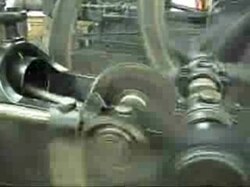
The Otto engine is a large stationary single-cylinder internal combustion four-stroke engine, designed by the German Nicolaus Otto. It was a low-RPM machine, and only fired every other stroke due to the Otto cycle, also designed by Otto.
Types Three types of internal combustion engines were designed by German inventors Nicolaus Otto and his partner Eugen Langen. The models were a failed 1862 compression engine, an 1864 atmospheric engine, and the 1876 Otto cycle engine known today as the petrol engine. The engines were initially used for stationary installations, as Otto had no interest in transportation. Other makers such as Daimler perfected the Otto engine for transportation use.
Timeline
Nicolaus August Otto as a young man was a traveling salesman for a grocery concern. In his travels he encountered the internal combustion engine built in Paris by Belgian expatriate Jean Joseph Etienne Lenoir. In 1860, Lenoir succeeded in creating a double-acting engine which ran on illuminating gas at 4% efficiency. The 18-litre (1,100 cu in) Lenoir engine was able to produce only 2 hp (1.5 kW). In testing a replica of the Lenoir engine in 1861 Otto became aware of the effects of compression on the fuel charge. In 1862 Otto attempted to produce an engine to improve on the poor efficiency and reliability of the Lenoir engine. He tried to create an engine which would compress the fuel mixture prior to ignition, but failed, as that engine would run no more than a few minutes prior to its destruction. Many engineers were also trying to solve the problem with no success. In 1864, Otto and Eugen Langen founded the first internal combustion engine production company NA Otto and Cie (NA Otto and Company). Otto and Cie succeeded in creating a successful atmospheric engine that same year. The factory ran out of space and was moved to the town of Deutz, Germany in 1869 where the company was renamed to Gasmotoren-Fabrik Deutz (The Gas Engine Manufacturing Company Deutz). Gottlieb Daimler was technical director and Wilhelm Maybach was the head of engine design. Daimler was a gunsmith who had also worked on the Lenoir engine previously.
By 1876, Otto and Langen succeeded in creating the first internal combustion engine that compressed the fuel mixture prior to combustion for far higher efficiency than any engine created to this time.
Atmospheric engine The first version of the atmospheric engine used a fluted column design which was the design of Eugen Langen. The atmospheric engine has its power stroke delivered upward using a rack and pinion to convert the piston's linear motion to rotary motion. The expansion ratio of this engine was much more effective than that of the 1860 Lenoir engine and gave the engine its superior efficiency. The Lenoir engine was an engine that burned fuel without first trying to compress the fuel/mixture. The Otto/Langen atmospheric engine ran at 12% efficiency and produced .5 hp (0.37 kW) at 80 rpm. In competition at the 1867 World's Fair in Paris, it easily bested the efficiency of the Lenoir engine and won the gold medal, thus paving the way for production and sales which funded additional research. The first version used a frame to stabilize the rack. This was soon dispensed with as the design was simplified. Later engines dispensed with the fluted cylinder as well. The atmospheric engine used a gas flame ignition system and was made in output sizes from 0.25 to 3 hp (0.19 to 2.24 kW). When in 1872 N.A. Otto & Cie reorganized as Gasmotoren-Fabrik Deutz, management picked Daimler as factory manager, bypassing even Otto, and Daimler joined the company in August, taking Maybach with him as chief designer. While Daimler managed to improve production, the weakness in the Otto's vertical piston design, coupled to Daimler's stubborn insistence on atmospheric engines, led the company to an impasse. For all its commercial success, with the company producing 634 engines a year by 1875, the Otto and Langen engine had hit a technical dead end: it produced only 3 hp (2.2 kW), yet required 3–4 m (10–13 ft) headroom to operate. In 1882, after producing 2,649 engines, the atmospheric engine production was discontinued. This was also the year that Gottlieb Daimler and Wilhelm Maybach left the company.
The Otto cycle After 14 years of research and development, Otto succeeded in creating the compressed charge internal combustion engine 9 May 1876. Otto found a way to layer the fuel mixture into the cylinder to cause the fuel to burn in a progressive, as opposed to explosive fashion. He referred to this as being a layered or stratified charge. This resulted in controlled combustion and a longer push of the piston in the cylinder rather than the explosion which destroyed all the engines attempted previously. The fuel was still illuminating gas just as Lenoir's and his own atmospheric engines had used. This engine used four cycles in its creation of power. It is known now as the Otto Cycle engine. This is the same engine that was first attempted in 1862. Otto turned his attention to the 4-stroke cycle largely due to the efforts of Franz Rings and Herman Schumm, brought into the company by Gottlieb Daimler. It is this engine (the Otto Silent Engine), and not the Otto & Langen engine, to which the Otto cycle refers. This was the first commercially successful engine to use in-cylinder compression (as patented by William Barnett in 1838). The Rings-Schumm engine appeared in autumn 1876 and was immediately successful. The cylinder arrangement of the compression engine was horizontal. It featured a slider valve control with gas flame ignition, which overcame the problems that Lenoir could not overcome with electric ignition which was unreliable at that time. In the 15 years prior to the development of the Otto engine power output never exceeded 3 hp (2.2 kW). In a few years after the Otto engine was developed engine power rose until it reached 1,000 hp (750 kW). The Otto Cycle engine was eventually adopted to run on Ligroin and eventually petrol and many gases. During WWII, Otto engines were run on more than 62 different fuels, such as wood gas, coal gas, propane, hydrogen, benzene, and many more. The engine is limited to light fuels. A later development of this engine, known as the Diesel engine, can burn heavy fuels and oils.
… excerpt ends here. Continue reading the full article.


