Phrase structure rules are a type of rewrite rule used to describe a given language's syntax and are closely associated with the early stages of transformational grammar, proposed by Noam Chomsky in 1957. They are used to break down a natural language sentence into its constituent parts, also known as syntactic categories, including both lexical categories (parts of speech) and phrasal categories. A grammar that uses phrase structure rules is a type of phrase structure grammar. Phrase structure rules as they are commonly employed operate according to the constituency relation, and a grammar that employs phrase structure rules is therefore a constituency grammar; as such, it stands in contrast to dependency grammars, which are based on the dependency relation.
Definition and examples Phrase structure rules are usually of the following form:
A → B C {\displaystyle A\to B\quad C}
meaning that the constituent A {\displaystyle A} is separated into the two subconstituents B {\displaystyle B} and C {\displaystyle C} . Some examples for English are as follows:
S ⟶ NP VP {\displaystyle {\ce {S->NP\quad VP}}}
NP ⟶ ( Det ) N 1 {\displaystyle {\ce {NP->(Det)\quad N1}}}
N 1 ⟶ ( AP ) N 1 ( PP ) {\displaystyle {\ce {N1->(AP)\quad N1\quad (PP)}}}
The first rule reads: A S (sentence) consists of a NP (noun phrase) followed by a VP (verb phrase). The second rule reads: A noun phrase consists of an optional Det (determiner) followed by a N (noun). The third rule means that a N (noun) can be preceded by an optional AP (adjective phrase) and followed by an optional PP (prepositional phrase). The round brackets indicate optional constituents. Beginning with the sentence symbol S, and applying the phrase structure rules successively, finally applying replacement rules to substitute actual words for the abstract symbols, it is possible to generate many proper sentences of English (or whichever language the rules are specified for). If the rules are correct, then any sentence produced in this way ought to be grammatically (syntactically) correct. It is also to be expected that the rules will generate syntactically correct but semantically nonsensical sentences, such as the following well-known example:
Colorless green ideas sleep furiously This sentence was constructed by Noam Chomsky as an illustration that phrase structure rules are capable of generating syntactically correct but semantically incorrect sentences. Phrase structure rules break sentences down into their constituent parts. These constituents are often represented as tree structures (dendrograms). The tree for Chomsky's sentence can be rendered as follows:
A constituent is any word or combination of words that is dominated by a single node. Thus each individual word is a constituent. Further, the subject NP Colorless green ideas, the minor NP green ideas, and the VP sleep furiously are constituents. Phrase structure rules and the tree structures that are associated with them are a form of immediate constituent analysis. In transformational grammar, systems of phrase structure rules are supplemented by transformation rules, which act on an existing syntactic structure to produce a new one (performing such operations as negation, passivization, etc.). These transformations are not strictly required for generation, as the sentences they produce could be generated by a suitably expanded system of phrase structure rules alone, but transformations provide greater economy and enable significant relations between sentences to be reflected in the grammar.
Top down An important aspect of phrase structure rules is that they view sentence structure from the top down. The category on the left of the arrow is a greater constituent and the immediate constituents to the right of the arrow are lesser constituents. Constituents are successively broken down into their parts as one moves down a list of phrase structure rules for a given sentence. This top-down view of sentence structure stands in contrast to much work done in modern theoretical syntax. In Minimalism for instance, sentence structure is generated from the bottom up. The operation Merge merges smaller constituents to create greater constituents until the greatest constituent (i.e. the sentence) is reached. In this regard, theoretical syntax abandoned phrase structure rules long ago, although their importance for computational linguistics seems to remain intact.
Alternative approaches
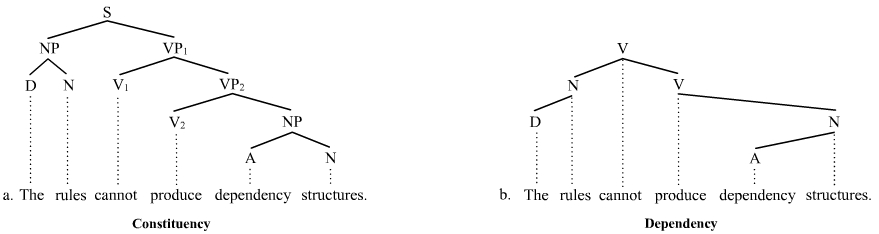
Constituency vs. dependency Phrase structure rules as they are commonly employed result in a view of sentence structure that is constituency-based. Thus, grammars that employ phrase structure rules are constituency grammars (= phrase structure grammars), as opposed to dependency grammars, which view sentence structure as dependency-based. What this means is that for phrase structure rules to be applicable at all, one has to pursue a constituency-based understanding of sentence structure. The constituency relation is a one-to-one-or-more correspondence. For every word in a sentence, there is at least one node in the syntactic structure that corresponds to that word. The dependency relation, in contrast, is a one-to-one relation; for every word in the sentence, there is exactly one node in the syntactic structure that corresponds to that word. The distinction is illustrated with the following trees:
… excerpt ends here. Continue reading the full article.