ArticleslgStudy

chemistry

Quadrangle (architecture)

Quadrangle (architecture) is a chemistry topic covered in the lgStudy science library. This page brings together a partial reference excerpt, illustrations, worked examples, real-world applications and a short study plan, so you can understand Quadrangle (architecture) rather than just read about it. In short: In architecture, a quadrangle (or colloquially, a quad) is a space or a courtyard, usually rectangular (square or oblong) in plan, the sides of which are entirely or mainly occupied by parts of a large building (or several smaller buildings). The word is probably most closely associated with college or university campus architecture, but quadrangles are also found in other buildings such as palaces.

Quadrangle (architecture) — main illustration
Quadrangle (architecture) — illustration

Key takeaways

  • Quadrangle (architecture) belongs to chemistry; place it in that map before memorising details.
  • Learn the definition first, then one example that makes the definition concrete.
  • Connect Quadrangle (architecture) to a quantity you can measure, compute or draw — that is where exam questions come from.
  • Reproduce the core statement of Quadrangle (architecture) from memory before moving on to harder problems.

Reference excerpt

In architecture, a quadrangle (or colloquially, a quad) is a space or a courtyard, usually rectangular (square or oblong) in plan, the sides of which are entirely or mainly occupied by parts of a large building (or several smaller buildings). The word is probably most closely associated with college or university campus architecture, but quadrangles are also found in other buildings such as palaces. Most quadrangles are open-air, though a few have been roofed over (often with glass), to provide additional space for social meeting areas or coffee shops for students. The word quadrangle was originally synonymous with quadrilateral, but this usage is now relatively uncommon.

Some modern quadrangles resemble cloister gardens of medieval monasteries, called garths, which were usually square or rectangular, enclosed by covered arcades or cloisters. However, it is clear from the oldest examples (such as Mob Quad) which are plain and unadorned with arcades, that the medieval colleges at Oxford and Cambridge were creating practical accommodation for college members. Grander quadrangles that look like cloisters came later, once the idea of a college was well established and benefactors or founders wished to create more monumental buildings. Although architectonically analogous, for historical reasons quads in the colleges of the University of Cambridge are always referred to as courts (such as the Trinity Great Court). In North America, Thomas Jefferson's design for the University of Virginia centered the housing and academic buildings in a Palladian form around three sides of the Lawn, a huge grassy expanse. Later, some American college and university planners imitated the Jeffersonian plan, the Oxbridge idea, Beaux-Arts forms, and other models. All five barracks at The Citadel (military college) feature quadrangles with red-and-white squares (the colors of the South Carolina battle flag), which are used for formations by the Corps of Cadets. Quadrangles are also found in traditional Kerala houses (Naalukettu) and is known as the Nadumittam ("Middle Space").

Notable quadrangles

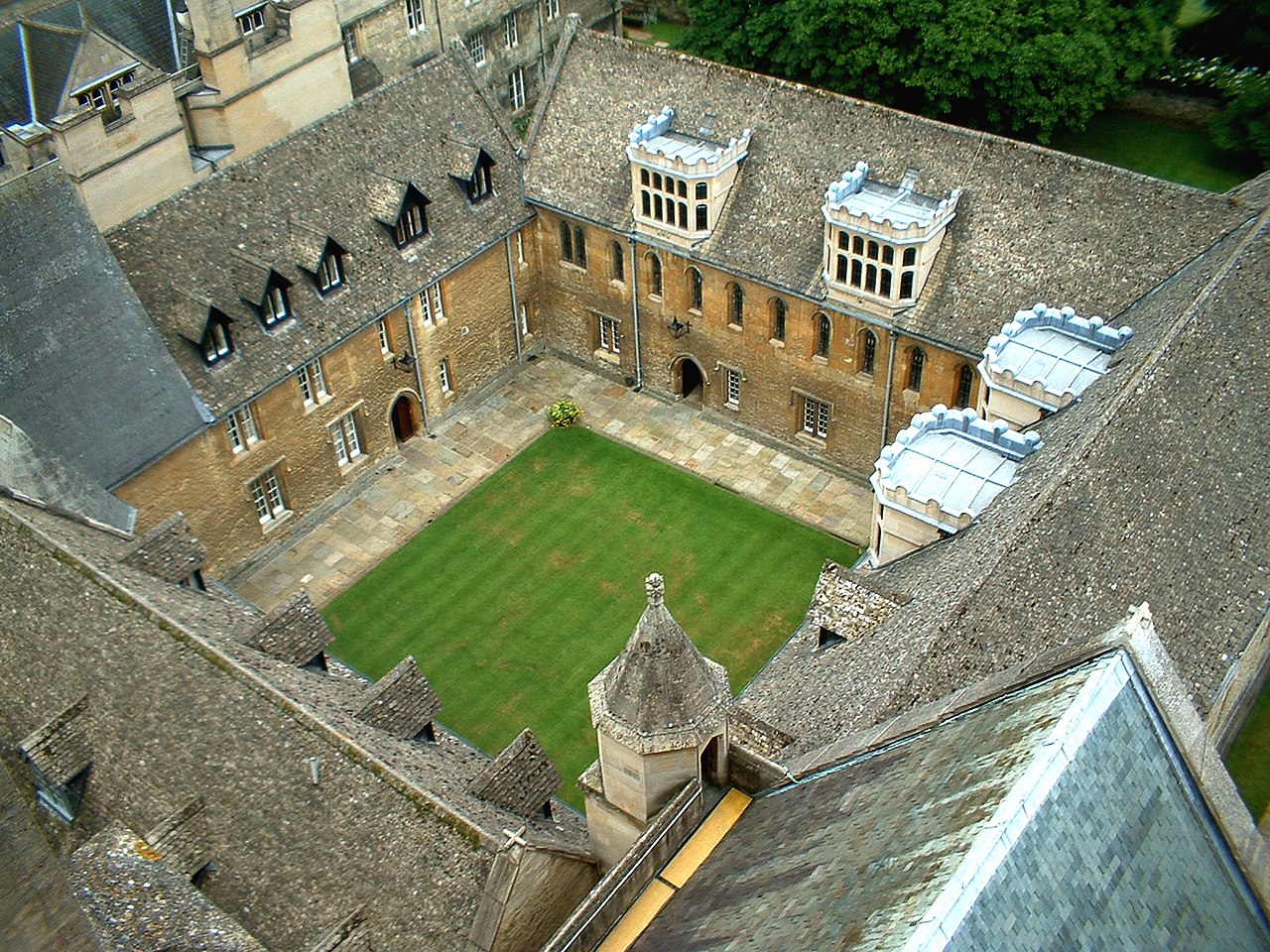
Woodburn Circle, West Virginia University Main Quad, University of Illinois Urbana-Champaign Blue Boar Quadrangle, Christ Church, Oxford Francis Quadrangle, University of Missouri Memorial Quadrangle, Yale University Mob Quad, Merton College, Oxford is one of the oldest quads in existence. Peckwater Quadrangle, Christ Church, Oxford Killian Court, Massachusetts Institute of Technology The Quad, Harvard University Harvard Yard, Harvard University Queen's Lawn, Imperial College London The Green, Dartmouth College King's College Quad, University of Aberdeen The Quadrangle, Springfield, Massachusetts Radcliffe Quadrangle, University College, Oxford Schenley Quadrangle, University of Pittsburgh Bascom Hill, University of Wisconsin–Madison Tom Quad, Christ Church, Oxford University University of Alabama Quad The Quad, University College London Founder's Building, Royal Holloway College, London The Diag, University of Michigan Sunken Garden, College of William & Mary The Lawn, University of Virginia McKeldin Mall, University of Maryland Old College, University of Edinburgh New College, University of Edinburgh Holyrood Quad, Moray House, Edinburgh Dahlgren Quadrangle, Georgetown University Old Campus, Yale University Main Quad, Stanford University Law Quadrangle, University of Michigan UVic Quad, University of Victoria Liberal Arts Quadrangle, University of Washington West Chester State College Quadrangle Historic District, West Chester University The Quadrangle, University of Pennsylvania El Cuadrángulo, University of Puerto Rico, Río Piedras Whitworth Hall Quadrangle, University of Manchester Hearn Plaza, Wake Forest University Quadrangle, S.Thomas' College, Mount Lavinia

See also

Siheyuan – Historical type of residence in China Nālukettu – Traditional housing style in Kerala Haveli, a form of classical architecture from South Asia & Persia, which incorporates a quad for cooling ventilation in the hot climate, and the private enjoyment of the open sky by residents, in a very modest culture

Notes

Illustrations

Quadrangle (architecture): Tom Quad, Christ Church, Oxford
Tom Quad, Christ Church, Oxford
Quadrangle (architecture): Quadrangle of the University of Sydney
Quadrangle of the University of Sydney
Quadrangle (architecture): Mob Quad, Merton College, Oxford is often claimed to be the oldest university quadrangle
Mob Quad, Merton College, Oxford is often claimed to be the oldest university quadrangle
Quadrangle (architecture): Quadrangle of New College, Edinburgh
Quadrangle of New College, Edinburgh
Quadrangle (architecture): University College Cork quadrangle
University College Cork quadrangle

Worked examples

Example 1 — a first encounter with Quadrangle (architecture)

Start with the simplest possible case. Write down what Quadrangle (architecture) claims or describes in one sentence, then invent the smallest concrete situation in which that sentence is true. In chemistry, the smallest case is usually a single object, a single equation or a single measurement. Check that every symbol or term in your sentence has a meaning in that case.

Example 2 — changing one variable

Take the situation from Example 1 and change exactly one quantity: double it, halve it, or set it to zero. Predict what should happen to Quadrangle (architecture) before you calculate. Comparing your prediction with the result is the fastest way to find out whether you understand the idea or only the words.

Example 3 — an exam-style question

Typical questions about Quadrangle (architecture) ask you to (a) state it precisely, (b) apply it to given data, and (c) explain a limitation. Practise writing all three answers in under five minutes; the third part is what separates a full-mark answer from an average one.

Applications of Quadrangle (architecture)

In research
Quadrangle (architecture) appears in chemistry research whenever the underlying quantities have to be modelled precisely. Papers usually cite it as a starting assumption and then explore where it breaks down.
In technology and industry
Engineering practice reuses Quadrangle (architecture) in design rules, simulations and safety margins. Knowing the idea lets you read a specification sheet and understand why the numbers look the way they do.
In the classroom
Quadrangle (architecture) is common in secondary-school and first-year university syllabi. It links to neighbouring topics Architectural elements, Courtyards, University and college buildings and structures, so understanding it makes those chapters shorter.
In everyday life
Look for Quadrangle (architecture) outside the textbook — in sport, cooking, traffic, electronics or the sky above you. An example you found yourself is remembered far longer than one you were given.
Ask Teacher Smith questions about this articleOpens your AI tutor with a question about “Quadrangle (architecture)” →

Affiliate

Preply — study more efficiently by working with a personal tutor. 50% off.

How to study Quadrangle (architecture) in 20 minutes

  1. Read the reference excerpt below once, without taking notes.
  2. Close the page and write down what Quadrangle (architecture) means in your own words.
  3. Compare your version with the excerpt and mark what you missed.
  4. Work through the three examples above with pen and paper.
  5. Explain Quadrangle (architecture) out loud to somebody else — or to Teacher Smith in the lgStudy chat.

Frequently asked questions

What is Quadrangle (architecture) in simple terms?

In architecture, a quadrangle (or colloquially, a quad) is a space or a courtyard, usually rectangular (square or oblong) in plan, the sides of which are entirely or mainly occupied by parts of a large building (or several smaller buildings). The word is probably most closely associated with colleg…

Why does Quadrangle (architecture) matter?

Because it connects several chemistry ideas at once: it gives you a definition you can apply, a quantity you can calculate, and a way to check whether a result is plausible.

How should I study Quadrangle (architecture)?

Read the excerpt, restate it from memory, then work through the examples and applications listed on this page. The five-step study plan above takes about twenty minutes.

What does this page cover?

It gives you a compact reference excerpt plus original lgStudy explanations, examples, applications and study material on Quadrangle (architecture).

Tags

  • Architectural elements
  • Courtyards
  • University and college buildings and structures

Keep exploring