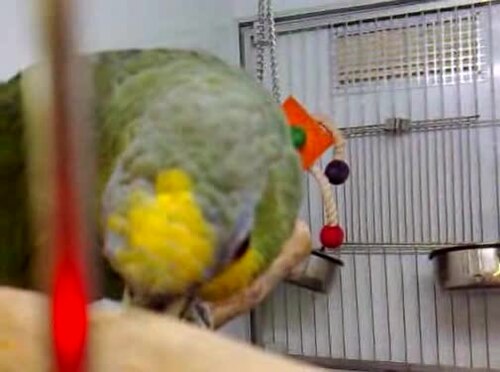
Talking birds are birds that can mimic the speech of humans. There is debate within the scientific community over whether some talking parrots also have some cognitive understanding of the language. Birds have varying degrees of talking ability: some, like the corvids, are able to mimic only a few words and phrases, while some budgerigars have been observed to have a vocabulary of almost 2,000 words. The common hill myna, a common pet, is well known for its talking ability and its relative, the common starling, is also adept at mimicry. Wild cockatoos in Australia have been reported to have learned human speech by cultural transmission from ex-captive birds that have integrated into the flock. The earliest reference to a talking bird comes from Ctesias in the 5th century BC. The bird, which he called Bittacus, may have been a plum-headed parakeet.
Process
The young of some birds learn to communicate vocally by social learning, imitating their parents, as well as the dominant birds of their flock. Lacking vocal cords, birds are thought to make tones and sounds using throat muscles and membranes – the syrinx in particular. There are likely to be limitations on the sounds that birds can mimic due to differences in anatomical structures, such as their lacking lips. It has been suggested that mimicry amongst birds is almost ubiquitous and it is likely that eventually, all species will be shown to be able to have some ability to mimic extra-specific sounds (but not necessarily human speech). Mimicking human speech is not limited to captive birds. Wild Australian magpies, lyrebirds and bowerbirds that interact with humans but remain free can still mimic human speech. Songbirds and parrots are the two groups of birds able to learn and mimic human speech. Both belong to the clade Psittacopasseres. If then introduced to wild birds, the wild birds may also mimic the new sounds. This phenomenon has been observed in public parks in Sydney, Australia, where wild parrots utter phrases such as "Hello darling!" and "What's happening?"
Types
Waterfowl (order Anseriformes)
Ducks, geese, swans (family Anatidae) A musk duck (Biziura lobata) named Ripper was recorded imitating human speech in 1987. No other waterfowl have been documented imitating speech.
Parrots (order Psittaciformes)
Cockatoos (family Cacatuidae) Galahs (Eolophus roseicapilla) can talk, although not as well as some other parrots. Male galahs are reportedly easier to teach than females. The long-billed corella (Cacatua tenuirostris) is described as being able to talk "very clearly". The sulphur-crested cockatoo (Cacatua sulphurea) is rated as a fair-to-good talker.
African and New World parrots (family Psittacidae) The African grey parrots (Psittacus) are particularly noted for their advanced cognitive abilities and their ability to talk. There are two commonly kept species of which the Timneh parrot (Psittacus timneh) tends to learn to speak at a younger age than the Congo parrot (Psittacus erithacus). Pet Congo greys may learn to speak within their first year, but many do not say their first word until 12–18 months old. Timnehs are generally observed to start speaking earlier, some in their late first year. The monk parakeet (Myiopsitta monachus), sometimes known as the quaker parakeet, is also a skilled talker. Many species of the genus Amazona are talkers, including the yellow-headed parrot (Amazona oratrix), yellow-crowned parrot (Amazona ochrocephala), yellow-naped parrot (Amazona auropalliata), blue-fronted parrot (Amazona aestiva), white-fronted parrot (Amazona albifrons), lilac-crowned amazon (Amazona finschi), orange-winged parrot (Amazona amazonica), Panama amazon (Amazona ochrocephala panamensis) and mealy parrot (Amazona farinosa). They tend to relate sounds to relationships more than grey parrots, thereby outperforming grey parrots in more social environments. Macaws can also be considered to be good talkers.
Old World parrots (family Psittaculidae) The Australian king parrot (Alisterus scapularis) can be trained to talk if it is hand-reared. The eclectus parrot (Eclectus) is a strong talker, although these abilities depend entirely on training from an early age. The slaty-headed parakeet (Psittacula himalayana) generally does not learn to talk. The blossom-headed parakeet (Psittacula roseata) is rare and therefore not often kept as a pet, however, they are good talkers. The Derbyan parakeet (Psittacula derbianais) is an excellent talker. The clarity of their speech has been compared to that of amazon parrots although they may not learn extensive vocabularies. The African rose-ringed parakeet (Psittacula krameri krameri), a subspecies of the rose-ringed parakeet, is also capable of can talking, but may require training at an early age to do. The Indian rose-ringed parakeet (Psittacula krameri manillensis), another subspecies of the rose-ringed parakeet, is an well-known talker and popular pet which can develop a large vocabulary and talk in sentences. The budgerigar, or common parakeet (Melopsittacus undulatus), is a popular talking-bird species because of their potential for large vocabularies, ease of care and well-socialized demeanor. Between 1954 and 1962, a budgerigar named Sparkie Williams held the record for having the largest vocabulary of a talking bird; at his death, he knew 531 words and 383 sentences. In 1995, a budgerigar named Puck was credited by Guinness World Records as having the largest vocabulary of any bird, at 1,728 words. The black-winged lovebird (Agapornis taranta) can talk if trained at an early age; however, they only rarely develop into competent talkers.
Passerines (order Passeriformes)
Lyrebirds (family Menuridae) In Australia, lyrebirds are great mimics of many sounds, including the human voice. Lyrebirds have three syringeal muscles whereas most other songbirds have four. This could make the syrinx of the lyrebird more flexible. In a study comparing the sonograms of lyrebirds and Australian magpies during mimicking, the author stated that the mimicry of the lyrebird was "impressionistic" while that of the magpie was "realistic".
Honeyeaters (family Meliphagidae) The tui is a bird of New Zealand that has been known to mimic human speech.
… excerpt ends here. Continue reading the full article.


