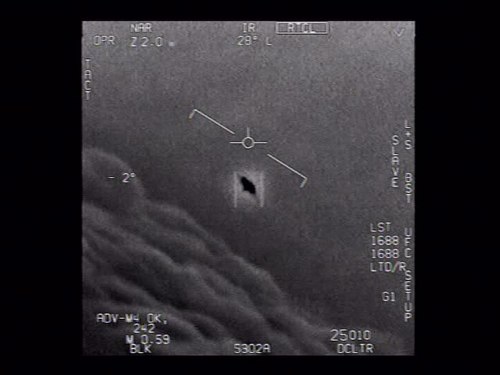
An unidentified flying object (UFO) is an object or phenomenon seen in the sky but not yet identified or explained. The term was coined when United States Air Force (USAF) investigations into flying saucers found too broad a range of shapes reported to consider them all saucers or discs. UFOs are also known as unidentified aerial phenomena or unidentified anomalous phenomena (UAPs). Upon investigation, most UFOs are identified as known objects, natural phenomena, hoaxes, or mirages, while a small number remain unexplained. While unusual sightings in the sky have been reported since at least the 3rd century BC, UFOs became culturally prominent after World War II, escalating during the Space Age. Studies and investigations into UFO reports conducted by governments (such as Project Blue Book in the United States and Project Condign in the United Kingdom), as well as by organisations and individuals have occurred over the years without confirmation of the fantastical claims of small but vocal groups of ufologists who favour unconventional or pseudoscientific hypotheses, often claiming that UFOs are evidence of extraterrestrial intelligence, technologically advanced cryptids, interdimensional contact, future time travelers, demons or the Dead. After decades of promotion of such ideas by believers and in popular media, the kind of evidence required to solidly support such claims has not been forthcoming. Scientists and skeptic organizations such as the Committee for Skeptical Inquiry have provided prosaic explanations for UFOs, namely that they are caused by natural phenomena, human technology, delusions, and hoaxes. Although certain beliefs surrounding UFOs have inspired parts of new religions, social scientists have identified the ongoing interest and storytelling surrounding UFOs as a modern example of folklore and mythology understandable with psychosocial explanations. The problems of temporarily or permanently non-knowable anomalous phenomenon or perceived objects in flight is part of the philosophical subject epistemology. The U.S. government has two entities dedicated to UFO data collection and analysis: NASA's UAP independent study team and the Department of Defense All-domain Anomaly Resolution Office.
Terminology and prevalence of belief During the late 1940s and through the 1950s, UFOs were often called "flying saucers" or "flying discs" based on reporting of the Kenneth Arnold incident. "Unidentified flying object" (UFO) has been in-use since 1947. The acronym "UFO" was coined by Captain Edward J. Ruppelt for the USAF. He wrote, "Obviously the term 'flying saucer' is misleading when applied to objects of every conceivable shape and performance. For this reason the military prefers the more general, if less colorful, name: unidentified flying objects. UFO". The term UFO became widespread during the 1950s, at first in technical literature, but later in popular use. "Unidentified aerial phenomenon" (UAP) first appeared in the late 1960s. UAP has seen increasing usage in the 21st century due to negative cultural associations with "UFO". UAP is sometimes expanded as "unidentified anomalous phenomenon". While technically a UFO refers to any unidentified flying object, in modern popular culture the term UFO has generally become synonymous with alien spacecraft. The term "extra-terrestrial vehicle" (ETV) is sometimes used to separate this explanation of UFOs from totally earthbound explanations. A 1995 Scripps poll found 50% of Americans "believe" in UFOs, while Newsweek reported a poll where 48% opined that "reports of UFOs are real". A 2012 survey found 36% US population believe UFOs are real. A 2017 Huffpo/YouGov poll found 48% believed UFOs could be a sign of aliens visiting Earth, while only 35% rejected the idea. A 2021 Gallup poll found 41% of Americans believed some UFOs involve alien spacecraft; Pew found 51% felt UFOs are "likely evidence of intelligent life outside Earth." The prevalence of UFOs belief led University of Leicester Professor of Media Barrie Gunter to observe: "even though Ufology enthusiasts have often been dismissed as quacks, there is a silent plurality of people who believe that they might be on to something".
Identification
Studies show that after careful investigation, the majority of UFOs can be identified as ordinary objects or phenomena. The 1952–1955 study for the USAF used the following categories: "Balloon; Astronomical; Aircraft; Light phenomenon; Birds, Clouds, dust, etc.; Insufficient information; Psychological manifestations; Unknown; and Other". Identified sources of UFO reports are:
Aircraft (including military, civilian, and experimental aircraft as well as such peculiarities as aerial advertising, missile and other rocket launches, artificial satellites, the International Space Station, re-entering spacecraft including space debris, kites, and various unmanned aerial vehicles often popularly termed "drones") Astronomical objects (bright stars, bolides, bright planets, and the Moon) Balloons (surveillance balloons, toy balloons, weather balloons, large research balloons, and sky lanterns) Hoaxes Light phenomena (mirages, Fata Morgana, sundogs, ball lightning, moon dogs, satellite flares, lens flare, searchlights and other ground lights, etc.) Other atmospheric objects and phenomena (birds, unusual clouds, flares, plasma) Psychological effects (pareidolia, suggestibility and false memories, mass psychogenic disorders, optical illusions, and hallucinations)
An individual 1979 study by CUFOS researcher Allan Hendry found, as did other investigations, that fewer than one percent of cases he investigated were hoaxes and most sightings were actually honest misidentifications of prosaic phenomena. Hendry attributed most of these to inexperience or misperception. Astronomer Andrew Fraknoi rejected the hypothesis that UFOs are extraterrestrial spacecraft and responded to the "onslaught of credulous coverage" in books, films and entertainment by teaching his students to apply critical thinking to such claims, advising them that "being a good scientist is not unlike being a good detective". According to Fraknoi, UFO reports "might at first seem mysterious", but "the more you investigate, the more likely you are to find that there is LESS to these stories than meets the eye".
History
Early history before the 20th century
… excerpt ends here. Continue reading the full article.

![Unidentified flying object: A Fata Morgana, a type of mirage in which objects located below the astronomical horizon appear to be hovering in the sky just above the horizon, may be responsible for some UFO sightings.[21]](https://upload.wikimedia.org/wikipedia/commons/thumb/f/f4/Fata_Morgana_Example.jpg/1280px-Fata_Morgana_Example.jpg?utm_source=en.wikipedia.org&utm_campaign=parser&utm_content=thumbnail)


