ArticleslgStudy

biology

Vertical dimension of occlusion

Vertical dimension of occlusion is a biology topic covered in the lgStudy science library. This page brings together a partial reference excerpt, illustrations, worked examples, real-world applications and a short study plan, so you can understand Vertical dimension of occlusion rather than just read about it. In short: Vertical dimension of occlusion, or VDO, also known as occlusal vertical dimension (OVD), is a term used in dentistry to indicate the superior-inferior relationship of the maxilla and the mandible when the teeth are occluded in maximum intercuspation. A VDO is not only possessed by people who have teeth, however; for completely edentulous individuals who do not have any teeth with which to position themselves in max…

Vertical dimension of occlusion — main illustration
Vertical dimension of occlusion — illustration

Key takeaways

  • Vertical dimension of occlusion belongs to biology; place it in that map before memorising details.
  • Learn the definition first, then one example that makes the definition concrete.
  • Connect Vertical dimension of occlusion to a quantity you can measure, compute or draw — that is where exam questions come from.
  • Reproduce the core statement of Vertical dimension of occlusion from memory before moving on to harder problems.

Reference excerpt

Vertical dimension of occlusion, or VDO, also known as occlusal vertical dimension (OVD), is a term used in dentistry to indicate the superior-inferior relationship of the maxilla and the mandible when the teeth are occluded in maximum intercuspation.

A VDO is not only possessed by people who have teeth, however; for completely edentulous individuals who do not have any teeth with which to position themselves in maximum intercuspation, VDO can be measured based on subjective signs related to esthetics and phonetics. In terms of esthetics, an appropriately measured VDO will appear to a layman's eye as an ordinary configuration of the patient's nose, lips and chin. An excessive VDO will appear as though the patient has something stuffed into their mouth, and the patient may not even be able to close their lips. A telltale indication of an excessive VDO is a patient straining to close their lips around the wax rims during VDO determination. Conversely, a deficient VDO will appear as though the patient's mouth has collapsed, and the chin appears too close to the nose; in essence, the patient would be over-closing their mouth because there would not be enough wax on the wax rims to maintain the proper vertical dimension of occlusion. In terms of phonetics, certain sounds are made by configuring the mouth in specific ways. The two sounds most commonly used to establish a patient's VDO are sibilant and fricative sounds. Sibiliant sounds are made by allowing the maxillary incisors to nearly touch the mandibular incisors, while fricative sounds are made by allowing the maxillary incisors to touch the slightly inverted lower lip at the wet-dry line. By having the patient count upwards from fifty and then upwards from sixty, the dentist can watch and listen to the patient attempting to make first fricative and then sibilant sounds and adjust the wax rims accordingly. A common trick is to ask the patient to say the name "Emma," as the position of the mandible immediately after completing the word is a rough estimate of the patient's proper VDO. The position after saying "Emma" is referred to as the vertical dimension at rest, or VDR. Historically, the VDO has been estimated at 3 mm less than VDR because a person will generally maintain their mandible at an opening of 3 mm when at rest. There is another rule that applies to many mammals which give us a very practical way to find a suitable VDO. Take the distance between the inner corner of the eye and the same corner of the lips (in older people the measurement should be done a little more medially (closer to the nose) to avoid a down-pointing lip corner). Using a ruler, apply this measurement between the center bottom of the nose (that rises from the upper lip) and lower tip of the mandible center. (In the completely edentulous (those with no teeth), do as referred.) Maintain a centric position.

References

Further reading Davis Henderson, Victor L. Steffel. McCRACKEN's Removable partial prosthodontics, 4th Edition, 1973.
Illustrations

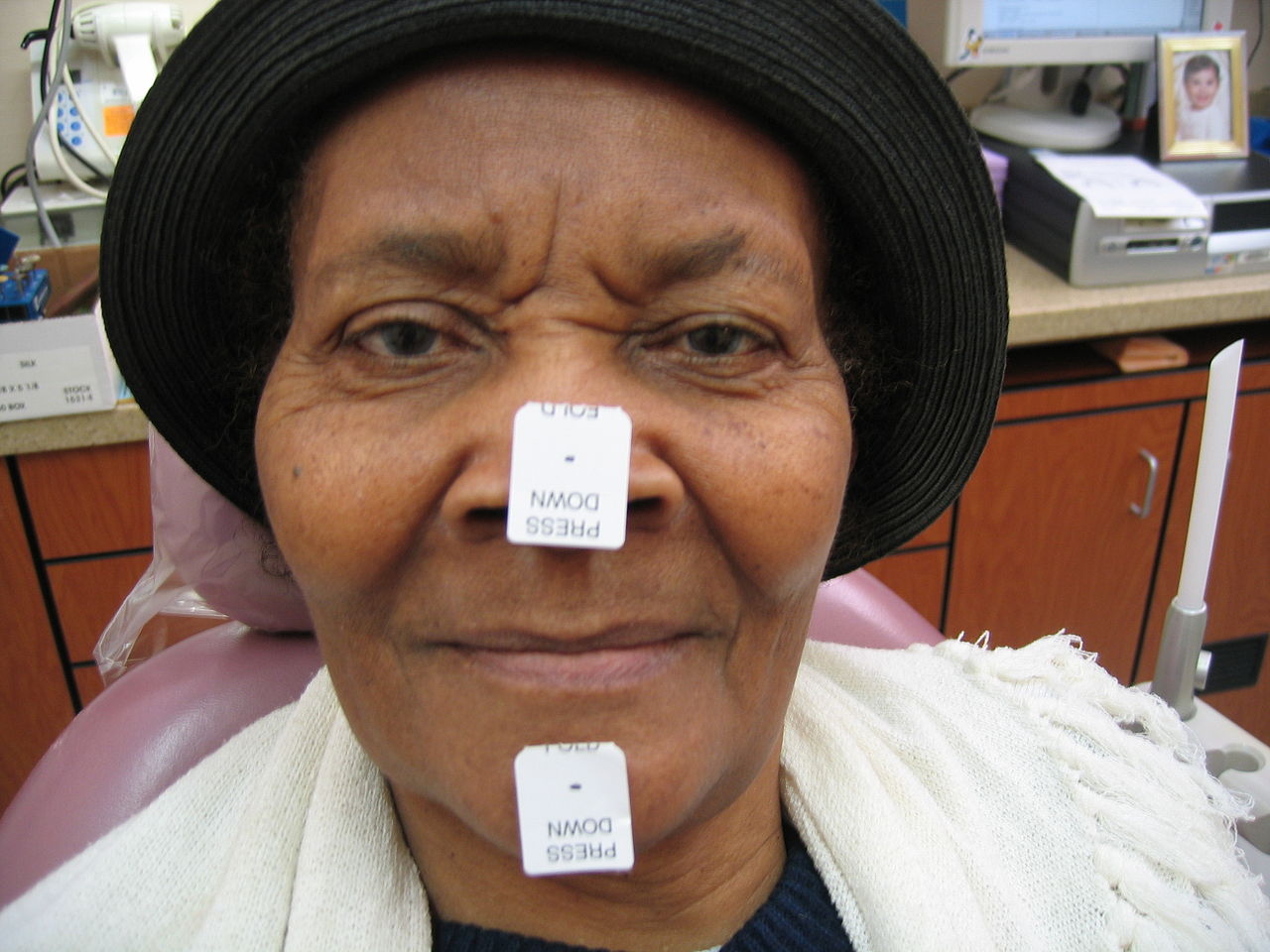
Vertical dimension of occlusion: A patient prepared for measurement of VDO. Two stickers have been affixed to her face in order to establish the distance between the dots drawn on the stickers when her mandible is in a position that matches her VDO.  Because this patient is completely edentulous (has no teeth), her VDO measurement will be subjectively based on esthetics and phonetics.
A patient prepared for measurement of VDO. Two stickers have been affixed to her face in order to establish the distance between the dots drawn on the stickers when her mandible is in a position that matches her VDO. Because this patient is completely edentulous (has no teeth), her VDO measurement will be subjectively based on esthetics and phonetics.
Vertical dimension of occlusion: Maxillary and mandibular record bases with notched wax rims. When placed in the mouth, these two preliminary appliances will be able to record a measured VDO because the patient will be unable to close further than the wax will allow.  The wax is built up or removed until the appropriate VDO has been established.  The two wax rims are then notched in order to allow an index of the relationship of the maxillary rim to the mandibular rim with a medium, such as Alluwax or Regisal.
Maxillary and mandibular record bases with notched wax rims. When placed in the mouth, these two preliminary appliances will be able to record a measured VDO because the patient will be unable to close further than the wax will allow. The wax is built up or removed until the appropriate VDO has been established. The two wax rims are then notched in order to allow an index of the relationship of the maxillary rim to the mandibular rim with a medium, such as Alluwax or Regisal.
Vertical dimension of occlusion: Loss of vertical dimension due to tooth decay and loss.
Loss of vertical dimension due to tooth decay and loss.

Worked examples

Example 1 — a first encounter with Vertical dimension of occlusion

Start with the simplest possible case. Write down what Vertical dimension of occlusion claims or describes in one sentence, then invent the smallest concrete situation in which that sentence is true. In biology, the smallest case is usually a single object, a single equation or a single measurement. Check that every symbol or term in your sentence has a meaning in that case.

Example 2 — changing one variable

Take the situation from Example 1 and change exactly one quantity: double it, halve it, or set it to zero. Predict what should happen to Vertical dimension of occlusion before you calculate. Comparing your prediction with the result is the fastest way to find out whether you understand the idea or only the words.

Example 3 — an exam-style question

Typical questions about Vertical dimension of occlusion ask you to (a) state it precisely, (b) apply it to given data, and (c) explain a limitation. Practise writing all three answers in under five minutes; the third part is what separates a full-mark answer from an average one.

Applications of Vertical dimension of occlusion

In research
Vertical dimension of occlusion appears in biology research whenever the underlying quantities have to be modelled precisely. Papers usually cite it as a starting assumption and then explore where it breaks down.
In technology and industry
Engineering practice reuses Vertical dimension of occlusion in design rules, simulations and safety margins. Knowing the idea lets you read a specification sheet and understand why the numbers look the way they do.
In the classroom
Vertical dimension of occlusion is common in secondary-school and first-year university syllabi. It links to neighbouring topics Dental anatomy, Prosthodontology, Restorative dentistry, so understanding it makes those chapters shorter.
In everyday life
Look for Vertical dimension of occlusion outside the textbook — in sport, cooking, traffic, electronics or the sky above you. An example you found yourself is remembered far longer than one you were given.
Ask Teacher Smith questions about this articleOpens your AI tutor with a question about “Vertical dimension of occlusion” →

Affiliate

Preply — study more efficiently by working with a personal tutor. 50% off.

How to study Vertical dimension of occlusion in 20 minutes

  1. Read the reference excerpt below once, without taking notes.
  2. Close the page and write down what Vertical dimension of occlusion means in your own words.
  3. Compare your version with the excerpt and mark what you missed.
  4. Work through the three examples above with pen and paper.
  5. Explain Vertical dimension of occlusion out loud to somebody else — or to Teacher Smith in the lgStudy chat.

Frequently asked questions

What is Vertical dimension of occlusion in simple terms?

Vertical dimension of occlusion, or VDO, also known as occlusal vertical dimension (OVD), is a term used in dentistry to indicate the superior-inferior relationship of the maxilla and the mandible when the teeth are occluded in maximum intercuspation. A VDO is not only possessed by people who have…

Why does Vertical dimension of occlusion matter?

Because it connects several biology ideas at once: it gives you a definition you can apply, a quantity you can calculate, and a way to check whether a result is plausible.

How should I study Vertical dimension of occlusion?

Read the excerpt, restate it from memory, then work through the examples and applications listed on this page. The five-step study plan above takes about twenty minutes.

What does this page cover?

It gives you a compact reference excerpt plus original lgStudy explanations, examples, applications and study material on Vertical dimension of occlusion.

Tags

  • Dental anatomy
  • Prosthodontology
  • Restorative dentistry

Keep exploring
